

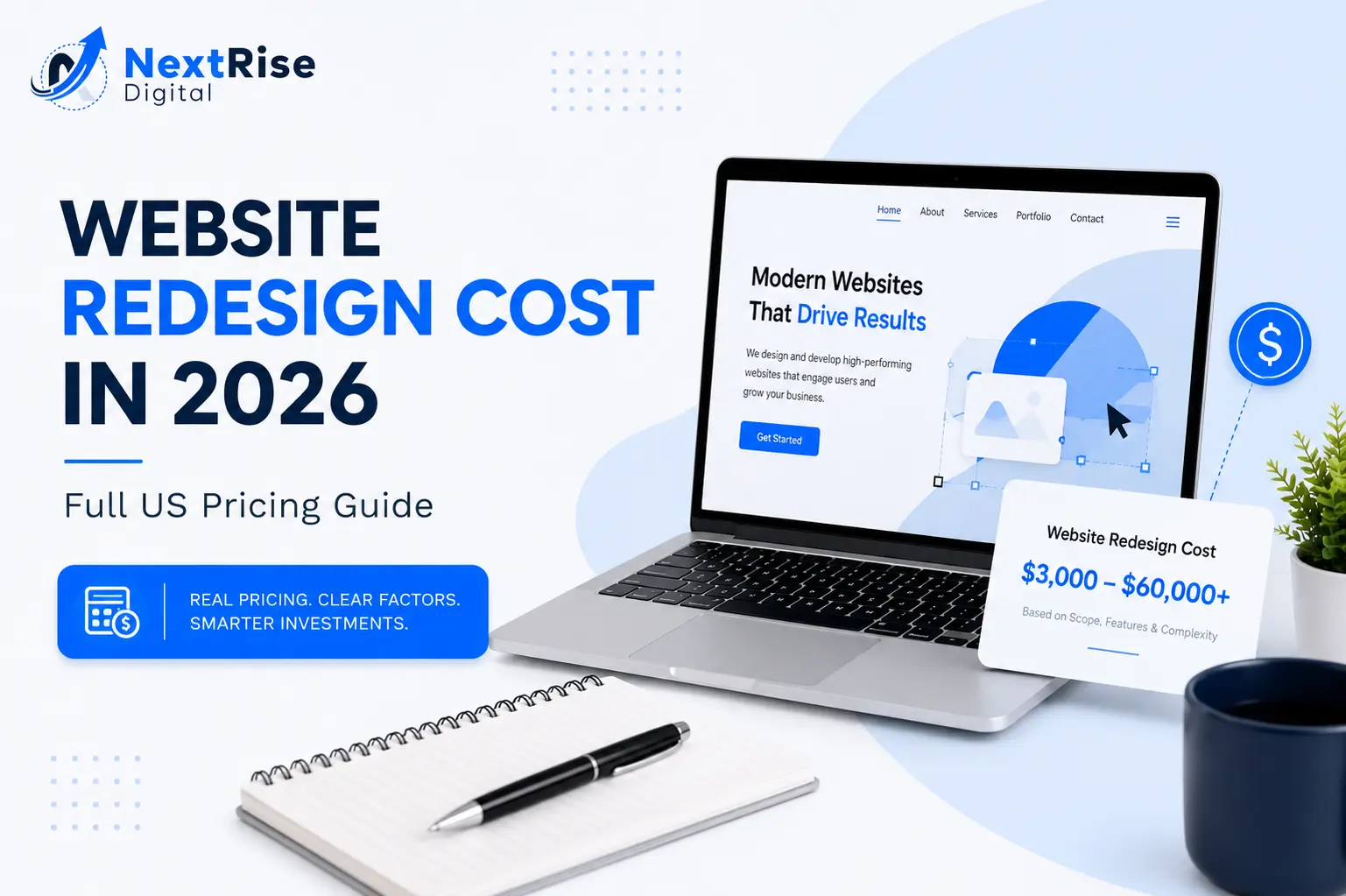
Website Redesign Cost in 2026: Full US Pricing Guide
If your website still looks and functions like it did five years ago, you have probably already asked the question that brings most business owners to this page: what does a website redesign cost in 2026? The honest answer is that it depends on your goals, but this guide breaks down real pricing tiers, the factors that move the number up or down, and how to know when a redesign will actually pay for itself.
At NextRise Digital, we have scoped and delivered redesign projects for startups, regional service businesses, and established US enterprises, so this guide reflects what agencies are actually quoting right now, not outdated averages from a few years ago.
Why Website Redesign Cost Varies So Much
There is no single price tag for a website redesign because “redesign” can mean a dozen different things. A local plumbing company refreshing its homepage and adding online booking has a very different scope than a manufacturer rebuilding a 200-page product catalog with a custom quoting tool. Before you can budget accurately, you need to know which category your project falls into.
Average Website Redesign Cost by Business Size (2026)
Here is a realistic breakdown of what US businesses are typically paying for a professional redesign:
- Small business / local service site (5-15 pages): $3,000 to $10,000
- Growing business with e-commerce or lead capture (15-40 pages): $10,000 to $25,000
- Mid-size company with custom functionality (booking, portals, integrations): $25,000 to $60,000
- Enterprise-level rebuild (multi-department, complex CMS migration): $60,000 and up
These figures assume a professional agency handling strategy, design, development, and quality assurance testing, not a freelancer working from a template. DIY page builders can be cheaper up front, but they often cost more later in lost conversions, security patches, and rework.
“Our old site was costing us leads every week. NextRise Digital scoped the redesign clearly, kept our budget on track, and our online booking requests doubled within two months of launch. Worth every dollar.” – Operations Manager, Coastal Fleet Services
What Factors Affect Website Redesign Cost
Several variables push the price of a redesign up or down. Understanding them helps you have a more productive conversation with any agency you hire.
1. Scope of Content and Page Count
More pages mean more copywriting, more design templates, and more QA hours. A 10-page site and a 100-page site are not the same project even if the visual style is similar.
2. Custom Functionality
Booking calendars, payment gateways, membership portals, and third-party API integrations all add development time. If your current site is mostly static and your redesign needs to add interactivity, budget accordingly.
3. Platform and CMS Migration
Moving from a legacy platform to WordPress, or restructuring an existing WordPress site with Elementor, changes the cost depending on how much content and how many redirects need to be mapped to avoid losing search rankings.
4. Design Complexity and Branding Work
A redesign that includes a full brand refresh, custom illustration, or a new design system costs more than one that reuses existing brand assets. Our creative and design services team typically scopes this separately from development so clients understand exactly what they are paying for.
5. SEO and Performance Requirements
A redesign that preserves or improves your search rankings requires a technical SEO audit, careful URL mapping, page speed optimization, and mobile testing. Skipping this step is one of the most common reasons businesses lose organic traffic after a redesign.
6. Quality Assurance and Testing
Cross-browser and cross-device testing, accessibility checks, and functional testing before launch protect your investment. Our quality assurance and testing process is built into every redesign project so bugs get caught before your customers find them, not after.
Signs Your Business Needs a Website Redesign
Not sure if a redesign is worth the investment right now? Consider a redesign if:
- Your bounce rate is high and time on site is low
- Your site is not mobile-friendly or loads slowly
- Your design looks dated compared to competitors
- You are getting traffic but few leads or sales
- Your CMS is outdated or difficult to update internally
- Your brand has evolved but your website has not
If two or more of these apply, the cost of not redesigning (lost leads, weaker brand perception, poor search visibility) is often higher than the cost of the project itself.
How to Get an Accurate Website Redesign Quote
Every agency prices differently, so use these steps to compare quotes fairly:
- Define your goals first. More leads, faster checkout, and better mobile experience all require different priorities.
- Ask what is included. Strategy, copywriting, design, development, QA, and post-launch support should each be itemized.
- Request a maintenance estimate. A cheap redesign with expensive ongoing maintenance is not actually cheap.
- Compare process, not just price. Our proven four-step process of discovery, proposal, development, and launch gives clients clarity at every stage, which is worth paying for.
Website Redesign ROI: Why the Investment Pays Off
A well-executed redesign typically improves conversion rate, average session duration, and organic search visibility within the first two to three months post-launch. Businesses that pair their redesign with an ongoing SEO and content strategy tend to see compounding returns well beyond the initial project cost. You can see real outcomes from past projects in our case studies, where redesigns were paired with marketing strategy to drive measurable growth.
Hidden Costs Businesses Often Overlook
A website redesign quote rarely tells the whole story. Before signing off on a budget, ask about these commonly overlooked line items:
- Content migration. Moving existing pages, blog posts, and product listings into a new structure takes real hours, especially if content needs to be rewritten rather than copied.
- Third-party licensing. Premium plugins, page builder licenses, and stock photography subscriptions can add ongoing annual costs beyond the initial build.
- Post-launch support. Bug fixes, small content updates, and monitoring in the first 30 to 60 days after launch should be scoped, not treated as free favors.
- Training time. If your team will manage content after launch, budget time for CMS training so the redesign does not become dependent on the agency for every small change.
Asking about these items upfront prevents budget surprises three months into a project.
Redesign vs. Rebuild: Choosing the Right Approach
Not every outdated website needs to be torn down and rebuilt from zero. In many cases, a strategic redesign that keeps a strong technical foundation while overhauling design, content, and key functionality delivers the same results at a lower cost than a full rebuild. A qualified agency should audit your existing site first and tell you honestly which approach actually makes sense, rather than defaulting to the more expensive option.
Signs a full rebuild is warranted include an outdated or unsupported CMS, significant security vulnerabilities, or a site architecture so tangled that incremental changes are no longer practical. Signs a redesign is sufficient include a solid technical foundation with design and content that simply have not kept pace with your brand or your customers’ expectations.
What a Professional Redesign Process Actually Looks Like
A well-run redesign typically follows four phases:
- Audit and discovery. Reviewing analytics, current conversion paths, technical SEO health, and stakeholder goals before any design work begins.
- Strategy and wireframing. Mapping the new site structure and user flows based on what the data and business goals actually indicate, not just aesthetic preference.
- Design and development. Building the visual design and functional site in tandem, with regular checkpoints so there are no surprises at the end.
- QA, launch, and post-launch monitoring. Testing thoroughly before going live, then monitoring performance and search visibility closely in the weeks after launch.
Agencies that skip straight to visual design without the audit and strategy phases tend to produce sites that look polished but do not actually solve the underlying problems that prompted the redesign in the first place.
Frequently Asked Questions
How much does a website redesign cost for a small business?
Most small businesses in the US pay between $3,000 and $10,000 for a professional redesign that includes strategy, design, development, and basic SEO setup.
Is it cheaper to redesign or build a new website from scratch?
Redesigning an existing site is usually less expensive than a full rebuild, especially if the existing content, structure, and SEO equity can be preserved and improved rather than replaced.
How long does a website redesign take?
A small business redesign typically takes four to eight weeks. Larger, custom-functionality projects can take three to six months depending on scope.
Will a redesign hurt my current SEO rankings?
It can if it is done carelessly. A proper redesign includes URL mapping, 301 redirects, and technical SEO review to protect and often improve your existing rankings.
Ready to Plan Your Website Redesign?
A website redesign is one of the highest-leverage investments a US business can make in its digital presence, but only when it is scoped correctly and executed by a team that understands both design and performance. If you are ready to talk numbers, timelines, and strategy, reach out to our team for a free consultation and a redesign estimate tailored to your goals.