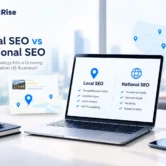


Local SEO vs National SEO: Which Strategy Fits a Growing Multi-Location US Business?

By Mir, SEO Expert, 7 years Digital Marketing Agency Experience.
When it comes to local SEO vs national SEO, the two aren’t opposite ends of one strategy — they solve different visibility problems, and a growing multi-location business usually needs a deliberate mix of both, not a straight switch from one to the other. If local SEO got your first location ranking well, it’s tempting to assume the same playbook just needs copying to each new city. It doesn’t, quite.

Key takeaways:
- Local SEO optimizes for “near me” and city-specific searches; national SEO optimizes for broader, non-location-specific searches.
- Adding locations means adding distinct, non-duplicated location pages and separate Google Business Profiles, not just more of the same content.
- NAP (Name, Address, Phone) consistency across every listing becomes more fragile, and more important, with every location added.
- A national brand-level page and individual local pages usually need to coexist, targeting different search intent rather than competing with each other.
- Trying to rank one generic page for every city is the most common structural mistake multi-location businesses make.
Local SEO vs National SEO: The Core Difference
Local SEO targets searches with clear geographic intent: “plumber near me,” “dentist in [city],” or a search that triggers Google’s local pack (the map with three business listings). It relies heavily on Google Business Profile optimization, location-specific content, local reviews, and NAP consistency.
National SEO targets searches without a location qualifier, competing for visibility across the entire country against every other business in the category, regardless of where either party operates. It relies more heavily on domain authority, content depth, and backlinks than on location signals.
A single-location business usually needs local SEO primarily, with national SEO relevant only if it sells a product or service that isn’t location-dependent (an online-only offering, for instance). A multi-location business needs both, layered deliberately rather than treated as a single undifferentiated strategy — which is really the heart of the local SEO vs national SEO decision for any growing brand.
What Changes When You Add a Second Location
The most common mistake is treating a second location as a content afterthought — a single new paragraph on an existing “our locations” page, rather than a properly built-out local presence. Three things specifically need attention:
- A distinct Google Business Profile per location, each with its own accurate address, phone number, hours, and photos. A single shared listing covering multiple physical locations actively works against local visibility for each one.
- A genuinely distinct location page per site, not a template with the city name swapped in. Google can and does treat near-duplicate location pages as low-value, which undermines the local pages you’re trying to build authority for. Each location page should reflect real, specific details about that location — local service area, local team, local reviews, sometimes local pricing.
- Consistent NAP (Name, Address, Phone) data across every directory, citation, and listing for every location. Inconsistency across locations is one of the more common, and more damaging, technical issues in multi-location local SEO, because it directly confuses the trust signals Google uses to verify a business’s legitimacy at each address.

Building a Strategy That Works at Both Levels
A workable multi-location structure typically looks like this:
- One strong national or brand-level page that ranks for broad, non-location-specific category terms and establishes overall domain authority.
- Individual, genuinely distinct location pages, each optimized for that specific city or service area, linked clearly from the main navigation and from each other.
- A unified review and reputation strategy across locations, since review volume and recency affect local pack visibility at each address independently.
- Centralized technical SEO and content strategy, so location pages benefit from the same underlying site authority rather than each location competing for resources in isolation.
| Local SEO | National SEO | |
|---|---|---|
| Primary intent captured | “Near me,” city-specific searches | Broad, non-geographic category searches |
| Key ranking factors | Google Business Profile, NAP consistency, local reviews | Domain authority, content depth, backlinks |
| Best fit for | Single-location or multi-location physical businesses | Businesses without a physical-location dependency, or brand-level pages |
| Multi-location approach | One distinct profile and page per location | One strong brand-level page supporting all locations |
How to Split Budget Between the Two
There’s no universal ratio that fits every business, but a useful starting heuristic: the more your revenue depends on customers physically visiting a specific location, the more your SEO effort should lean local rather than national.
A home-services business where nearly every customer finds them through a “near me” search might put the large majority of SEO effort into local (Google Business Profile, location pages, reviews), with only a smaller share going toward the brand-level national page. A business selling nationally with a few physical showrooms would flip that ratio, since most of its demand doesn’t come from map-pack visibility at all.
The practical way to set your own ratio: look at where your existing leads or customers actually come from today — the local pack, or broad organic search — and weight next quarter’s SEO effort toward whichever channel is already proving out, adjusting as each location matures rather than locking in a fixed split for the life of the strategy.
What This Looks Like in Practice
For example, a regional service business expanding from one city to three might keep a single strong national/brand page targeting its core category term, while building out three genuinely distinct location pages, each with its own Google Business Profile, local service-area content, and location-specific reviews, rather than duplicating one template three times. This is an illustrative pattern, not a documented client outcome.
At Next Rise Digital, multi-location SEO engagements are structured around exactly this layered approach rather than a one-size-fits-all local package. You can review how we structure ongoing SEO work on our process page, and see how it connects to the rest of our marketing services on our digital marketing services page.
If you’re earlier in the process and wondering how long any of this takes to show up in results, see our companion guide on how long SEO takes to work — the same general timeline applies per location, with newer locations effectively starting their own version of that clock.
Local pack vs. national organic result
Two different rankings, two different playbooks. Here's what actually earns each spot.
Local pack
"plumber near me"
Driven by
Captures proximity-based searches
National organic
broad category search
Driven by
Captures research-stage searches
Frequently Asked Questions
Local SEO vs national SEO – which one does my business actually need?
If most customers find you through a physical visit or service area, lean local; if your product or service has no location dependency, lean national. Most multi-location businesses need a deliberate mix of both rather than picking one over the other.
Do I need a separate website for each location?
Usually not a separate full website — a single site with distinct, well-built-out pages per location typically performs better than fragmenting authority across multiple separate domains, unless locations operate as genuinely separate brands.
How many Google Business Profiles do I need for 3 locations?
Three — one per physical address, each verified and managed individually, even if they share the same overall business name and branding.
Can one location page just be duplicated for each city?
No. Near-duplicate location pages tend to underperform and can be treated as low-value by Google. Each page needs genuinely distinct, location-specific content to rank well.
Does national SEO help my local locations at all?
Yes, indirectly. A strong national/brand-level presence builds overall domain authority, which supports every local page on the same site, even though the local pages are what actually capture “near me” searches.
What’s the biggest local SEO mistake multi-location businesses make?
Inconsistent NAP (name, address, phone) data across directories and listings for different locations, which confuses the trust signals Google uses to verify each address independently.
Not sure whether you need a local-first strategy, a national push, or both? Book a free strategy consultation and we’ll tell you honestly which mix fits your locations and growth stage, based on where your leads actually come from rather than a generic sales script.