

Content Marketing Strategy: 7 Proven Ways to Boost Traffic
Building a winning content marketing strategy is no longer optional for US businesses competing online in 2026. Companies without a documented strategy consistently underperform those that plan, measure, and refine their content on purpose. This guide walks through seven proven ways to build a content marketing strategy that drives real traffic, leads, and revenue, not just page views.
Whether you’re starting from scratch or trying to fix a strategy that has stalled, these tactics are built for practical execution, not theory.
Why Every Business Needs a Content Marketing Strategy
A content marketing strategy is the difference between publishing content and building an asset. Businesses that treat content as an afterthought, publishing sporadically with no clear goal, rarely see meaningful returns. Businesses that treat content strategically, with defined audiences, formats, and distribution plans, build compounding traffic and authority over time. According to research from the Pew Research Center’s Internet & Technology division, the vast majority of American adults now research products and services online before making a purchase decision, which means your content is often the first true interaction a prospective customer has with your brand.1. Start With Audience Research, Not Topic Ideas
The single biggest mistake in content marketing is starting with what you want to say instead of what your audience actually needs to know. Before writing a single headline, invest time in understanding:- What questions your ideal customers are actually typing into search engines
- Which pain points come up repeatedly in sales calls or customer support tickets
- What competitors are ranking for that you are not yet covering
- Where your audience spends time online, whether that’s search, social, or email
Building Buyer Personas That Actually Work
Generic buyer personas filled with made-up hobbies and stock photos rarely help. Instead, build personas around real, observable behavior: the specific questions prospects ask, the objections that come up before a sale, and the content formats they engage with most (video, long-form guides, quick tips, and so on). The more specific your persona, the more targeted and effective your content becomes.2. Set Clear, Measurable Goals
A content marketing strategy without goals is just a content calendar. Before producing anything, define what success actually looks like. Common goals include:- Organic traffic growth to specific landing pages or the site overall
- Lead generation through gated content, contact forms, or newsletter signups
- Brand authority measured through backlinks, mentions, and search visibility
- Sales enablement by creating content that helps close deals faster
3. Build a Content Calendar Around Search Intent
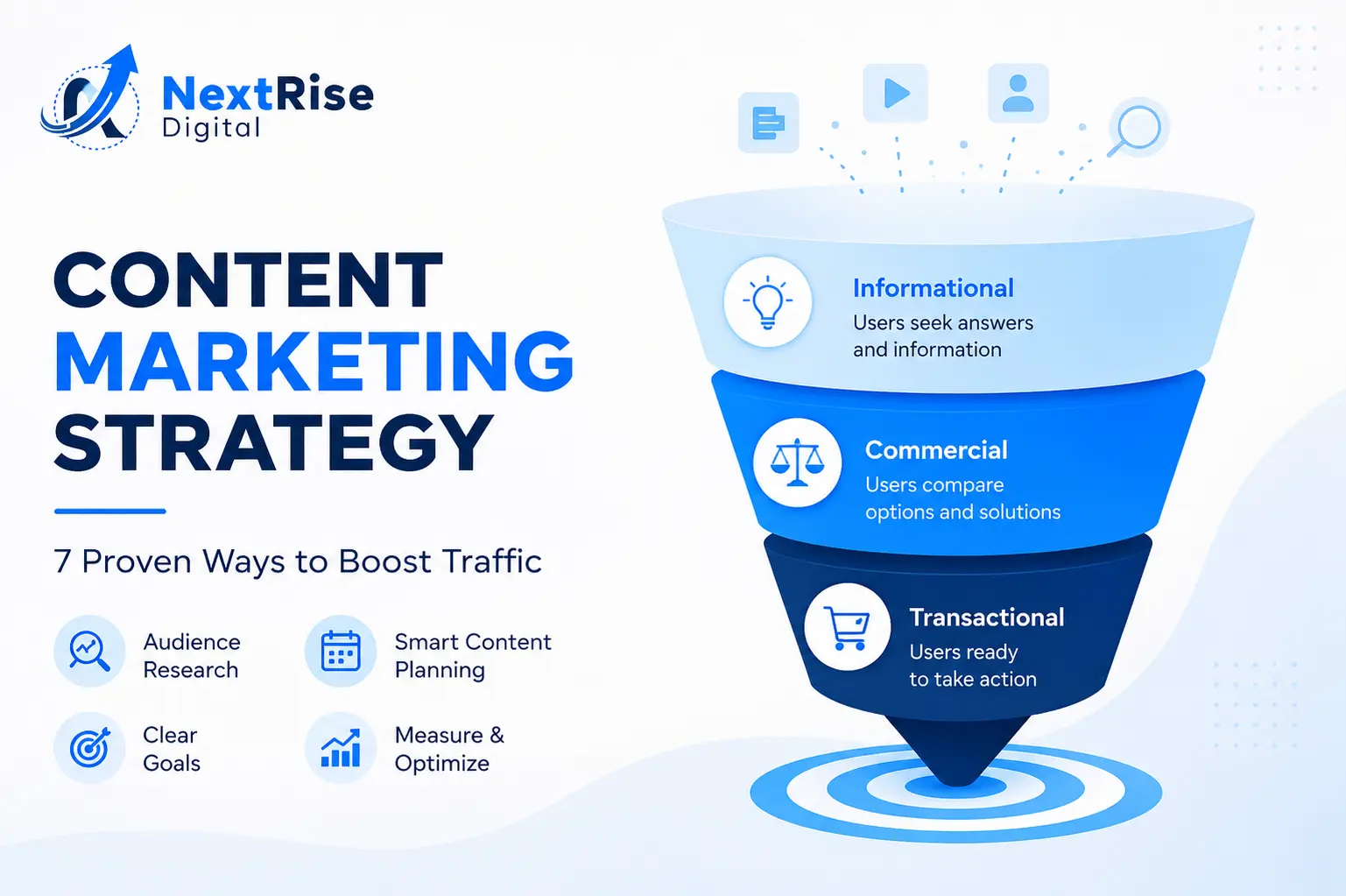
Search intent, meaning what a user actually wants when they type a query, should guide every piece of content you produce. Broadly, search intent falls into four categories:- Informational: The user wants to learn something (“what is content marketing”)
- Navigational: The user is looking for a specific brand or site
- Commercial investigation: The user is comparing options before buying
- Transactional: The user is ready to make a purchase or take action
“Next Rise Digital helped us build our first real content marketing strategy instead of publishing randomly. Our organic traffic has grown steadily every month since we started following their plan.” – Danielle Foster, VP of Marketing, Bridgeway Financial Group
4. Diversify Your Content Formats
Written blog posts remain a foundation of most content strategies, but relying exclusively on one format limits your reach. Consider incorporating:
- Long-form guides that thoroughly answer a topic and attract backlinks
- Video content for platforms where your audience already spends time
- Infographics that simplify complex data into shareable visuals
- Case studies that provide social proof through real client results
- Email newsletters that nurture leads who aren’t ready to buy yet
Repurposing one core piece of research or expertise across multiple formats also extends its lifespan and reach without multiplying your production workload.
5. Prioritize On-Page SEO for Every Piece
Even the best-researched, most valuable content will underperform if it isn’t structured for search engines to understand and rank it. Every piece of content in your strategy should include:
- A clear, keyword-focused title and heading structure
- Internal links connecting related content on your site
- Optimized meta descriptions that encourage clicks from search results
- Fast-loading pages, since performance directly impacts both rankings and user experience
Businesses building out a broader content plan often benefit from pairing it with dedicated digital marketing services that handle technical SEO alongside content production, ensuring nothing falls through the cracks between strategy and execution.
6. Distribute and Promote, Don’t Just Publish
Publishing content and hoping it ranks organically is a slow, unreliable strategy on its own. A strong content marketing strategy includes a distribution plan for every piece, such as:
- Sharing across relevant social media channels
- Including new content in email newsletters
- Repurposing key sections into short-form social posts
- Reaching out to industry publications or partners for potential syndication
Distribution accelerates the initial traction a piece of content needs before organic search rankings catch up, which can otherwise take months for competitive topics.
7. Measure, Analyze, and Refine Continuously
A content marketing strategy is never truly finished. The businesses that see the strongest long-term results treat content as an ongoing, iterative process rather than a one-time project. Review performance regularly, tracking metrics such as:
- Organic traffic and keyword rankings over time
- Time on page and bounce rate as engagement indicators
- Conversion rate from content to lead or sale
- Backlinks earned from published pieces
Use this data to double down on what’s working and revise or retire what isn’t. Content that performed well eighteen months ago may need updating to stay competitive as search results and audience expectations evolve. For broader guidance on structuring an editorial process from research through publication, resources like the U.S. Small Business Administration’s marketing and sales guidance offer a useful foundation for businesses building their first formal plan.
Common Content Marketing Mistakes to Avoid
- Publishing without a strategy, creating content reactively instead of purposefully
- Ignoring search intent, producing content that doesn’t match what searchers actually want
- Ignoring distribution, assuming great content will find its audience on its own
- Never updating older content, letting once-strong pages slowly decline in rankings
- Focusing only on quantity, sacrificing depth and quality for publishing frequency
How Content Marketing Strategy Supports Broader Business Growth
A strong content marketing strategy rarely operates in isolation. It works best alongside a well-designed website that converts the traffic content generates, and a broader marketing plan that includes paid search or social advertising to accelerate reach. Businesses that have already tackled foundational questions around small business website design often see stronger returns from content, since visitors arriving from organic search land on a fast, conversion-optimized experience rather than a generic, outdated page.
Similarly, businesses weighing how to split budget between organic and paid efforts may find it useful to review a breakdown of SEO versus PPC return on investment, since content marketing strategy and SEO are deeply interconnected disciplines.
Real-World Example: How a Documented Strategy Changes Outcomes
Consider two businesses in the same industry. The first publishes blog posts inconsistently, whenever someone on the team has spare time, with no clear target audience or keyword focus. The second maintains a documented content marketing strategy: a content calendar built around researched search intent, a mix of formats, and monthly performance reviews.
Over a twelve-month period, the second business typically sees compounding organic traffic growth, since each piece of content builds on validated keyword research and internal linking from previous posts. The first business, by contrast, often sees flat or declining traffic, since content without a strategic foundation rarely builds the topical authority search engines reward. This gap tends to widen over time, since organic search increasingly favors sites that demonstrate depth and consistency around a subject area, a concept often referred to as topical authority.
Data-Backed Reasons to Invest in a Content Marketing Strategy
Businesses sometimes treat a content marketing strategy as a nice-to-have rather than a core growth channel. The data tells a different story. Organic search consistently ranks as one of the highest-ROI channels available to businesses precisely because a documented content marketing strategy keeps producing value long after the initial investment, unlike paid advertising that stops generating traffic the moment budget runs out.
Companies that maintain an active content marketing strategy also tend to build stronger domain authority over time, which makes every new piece of content easier to rank than it would have been without that foundation. This compounding effect is one of the strongest arguments for committing to a long-term content marketing strategy rather than treating content as a short-term campaign with a defined start and end date.
Building Internal Buy-In for Your Content Marketing Strategy
Even a well-researched content marketing strategy can stall without support from leadership and other departments. Sales teams often have direct insight into customer objections that should shape content topics. Customer support teams frequently know exactly which questions come up most often. Bringing these teams into the planning process not only improves the quality of your content marketing strategy, it also builds internal champions who help distribute and reference that content in their own conversations with prospects and customers.
Reporting results regularly, even informally, also helps maintain buy-in. Sharing a simple monthly update showing organic traffic growth, top-performing pieces, and leads generated keeps your content marketing strategy visible and valued across the organization, rather than existing as a siloed project only the marketing team understands.
Scaling Your Content Marketing Strategy as You Grow
A content marketing strategy that works well for a small catalog of blog posts needs to evolve as your content library grows. Businesses managing hundreds of published pieces face different challenges than those just getting started, including:
- Content audits to identify older pieces that need updating, consolidating, or retiring entirely
- Topic clustering to organize related content around pillar pages that reinforce topical authority
- Workflow systems to manage a growing team of writers, editors, and subject matter experts
- Governance guidelines to maintain consistent voice, quality, and SEO standards as more people contribute
Businesses that plan for this evolution early, even while their content marketing strategy is still relatively small, tend to scale more smoothly than those that only think about structure and governance after their content library has already become unwieldy and difficult to manage.
Case Study Snapshot: What a Documented Strategy Changes in Practice
Consider a regional home services company that previously published blog content only when someone had spare time between projects. After adopting a documented content marketing strategy, including keyword research, a content calendar built around search intent, and monthly performance reviews, the business began publishing consistently around topics its own sales team confirmed customers actually asked about before booking a service.
Within the first two quarters, organic traffic to service-related pages grew steadily, driven largely by informational content that answered common pre-purchase questions. More importantly, the business started tracking which specific articles correlated with form submissions, allowing the team to double down on topics that converted well and phase out formats that generated traffic without meaningful business impact. This kind of disciplined, data-informed content marketing strategy consistently separates businesses that treat content as a real growth channel from those still treating it as an occasional side project.
Aligning Your Content Marketing Strategy With the Sales Funnel
A mature content marketing strategy maps content deliberately to each stage of the buyer’s journey rather than producing pieces in isolation. Top-of-funnel content should focus on answering broad questions and building awareness, without pushing a hard sell. Middle-of-funnel content can start introducing your specific approach or methodology, building credibility as a viable solution. Bottom-of-funnel content, including case studies, comparison guides, and pricing breakdowns, should directly support a prospect’s final decision-making process.
Mapping existing content against this funnel often reveals gaps. Many businesses accumulate plenty of top-of-funnel blog posts but very little content actually designed to close a sale, leaving prospects who are ready to buy without the specific, detailed information they need to move forward confidently. Auditing your content marketing strategy against this framework at least twice a year helps ensure balanced coverage across every stage of the funnel, not just the easiest content to produce.
Tools That Support an Efficient Content Marketing Strategy
Executing a content marketing strategy well at scale typically requires some combination of supporting tools, even for a lean team. Keyword research tools help validate topic ideas against real search volume before committing writing time to them. Editorial calendar tools keep a growing content marketing strategy organized across writers, editors, and publish dates. Analytics platforms provide the performance data needed to continuously refine which topics and formats are actually working.
Smaller teams don’t need an expensive enterprise stack to execute a solid content marketing strategy. Many businesses start with a simple shared calendar and free or low-cost analytics tools, only investing in more sophisticated software once their content marketing strategy has proven its value and justified a larger budget for supporting infrastructure.
Frequently Asked Questions
How long does a content marketing strategy take to show results?
Most businesses begin seeing measurable organic traffic growth within four to six months, though highly competitive industries may take longer. Consistency and quality matter more than speed in the early stages.
How often should I publish new content?
Consistency matters more than volume. A well-researched piece published every two weeks will typically outperform four rushed, low-value posts published in the same period.
Do I need a large budget to execute a content marketing strategy?
No. A focused strategy targeting a realistic set of keywords with high-quality, well-optimized content often outperforms a larger budget spent on generic, unfocused content production.
Should I focus on blog content or video content first?
This depends on where your audience already spends time and what format best explains your product or service. Many businesses start with written content since it supports both SEO and can be repurposed into other formats later.
How do I measure the ROI of my content marketing strategy?
Track organic traffic growth, lead generation from content-driven conversions, and keyword ranking improvements over time, then compare that value against your content production costs to calculate return on investment.
Building a Strategy That Compounds Over Time
A strong content marketing strategy is built on real audience research, clear goals, search-intent-driven planning, diverse formats, solid on-page SEO, active distribution, and continuous measurement. Businesses that commit to this process consistently outperform those publishing content without a plan, building compounding organic traffic that pays off well beyond the initial investment.
Ready to build a content marketing strategy tailored to your business goals? Contact our team for a free strategy consultation and start turning content into measurable growth.